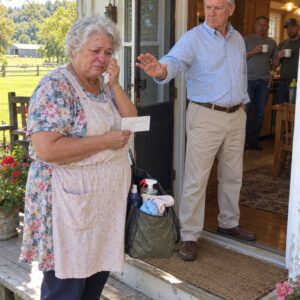
There, printed in black ink, was my full name: ELNORA RUTHANNE WHITSETT. Beneath it was a legal deed transferring thirty-eight acres of land, including the little white tenant house where I had learned to walk and the forty-one pecan trees my family had loved for generations. The land had once belonged to my great-grandfather, Isaac Whitsett, who had purchased it with his own labor in 1879. But in 1931, a member of the Lockridge family had taken it through a fraudulent tax sale after deliberately raising Isaac’s property assessment. The price? Just forty-two dollars. My family had remained on that same land for decades, working for the people who had taken it from us, never knowing what had truly happened. Henrietta had discovered the evidence in an old trunk in her attic. Heartbroken by the truth, she had hired her own attorney and arranged to return the land to me before she died. Rosella explained that Carlton had witnessed the signing and knew the entire story. The cruel dismissal at the back door had been his way of getting me away from his brothers before they discovered the deed. When I finally turned the three-hundred-dollar check over, I found a tiny message written in pencil: “Don’t cash this. Go see Rosella. — C.”
The truth soon came out. Thurston had already signed a contract to sell the entire farm to a developer for a massive housing project, believing he would inherit every acre. When he discovered that the thirty-eight acres belonged to me, he threatened to take me to court. But Henrietta had anticipated the challenge. Her lawyer produced a video showing that Henrietta understood exactly what she was doing when she signed the deed, and the judge upheld her decision. The development deal collapsed, and I moved back into the little white house where my mother had died and where my own story had begun. I turned down a million-two-hundred-thousand-dollar offer for the land. Some things, I realized, cannot be measured by money. My great-grandfather had lost his home because someone decided his hard work and dignity were worth less than forty-two dollars. I would not let that land disappear beneath a subdivision. Today, a wooden sign at the entrance reads WHITSETT GROVE — EST. 1879 — RETURNED 2025. My daughter visits on Sundays, and my grandsons help me gather pecans beneath the old trees. Above my kitchen table hangs the stained napkin on which Henrietta carefully wrote my name. Beside it hangs the uncashed check, turned over to reveal Carlton’s message. Every Friday morning, I still make coffee and biscuits and set two cups on the table. Then I remember Henrietta’s words: “The dirt will wait. I won’t.” For most of my life, I believed the greatest thing I had lost was the chance to own a home of my own. Now I understand that what was returned to me was something even greater: the truth about my family, the dignity of our history, and the knowledge that our names deserved to be written correctly all along.