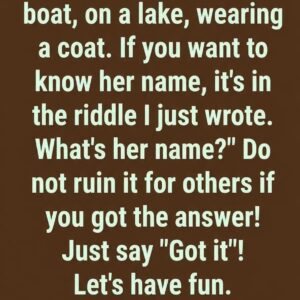
The intended answer in this version of the riddle is “There.” The trick relies on treating a word in the question as though it were the woman’s name, rather than assuming that the puzzle is asking for information about a real person. Instead of searching for clues about her identity, the reader is encouraged to look at the language itself. This is a familiar technique in wordplay: a question appears to ask for one kind of information, but its wording invites an unexpected interpretation. The lake, the boat, and the coat provide a vivid distraction, while the proposed answer shifts attention toward a single word. However, there is an important catch. The answer is not logically established by the ordinary description of a woman sitting in a boat. Unless the original wording explicitly connects “There” to her identity through a clear pun or an additional clue, her actual name cannot be determined from the information provided. That distinction matters because a clever interpretation and a fully supported solution are not always the same thing.
And that is part of the appeal of riddles like this one. They encourage us to question our first assumptions, examine familiar phrases more carefully, and enjoy the moment when an unexpected possibility appears. At the same time, they remind us that not every viral puzzle has one universally accepted answer. Some depend on precise wording, some are passed along with missing clues, and others become popular because people enjoy debating whether the proposed solution really makes sense. So, if you immediately thought the riddle was impossible, you were not necessarily overlooking something obvious. You may simply have noticed that the question does not provide enough information to identify the woman. If you enjoyed the wordplay, try sharing the puzzle with a friend without revealing the suggested answer and see how they approach it. Their reaction might be the most entertaining part of the challenge. After all, the best riddles do more than test how quickly we can answer a question—they make us reconsider how the question was asked in the first place.