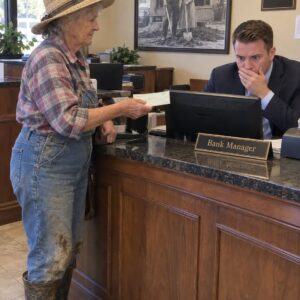
What Brandon discovered was a legal agreement that gave the holder of Account Number 0001 extraordinary rights. Under Section 14.3, no Farmers & Merchants branch within Millbrook could be closed or have its staff reduced without that account holder’s written consent. Even more remarkably, the agreement established that the bank building itself belonged to the holder of the account, who leased it to the bank for just one dollar a year. George had anticipated what large corporations might eventually do to small towns, and he had created a way to protect the community long after he was gone. When Brandon’s phone call reached Heartland’s president, Richard Hale, the truth emerged. Brandon had been sent to close the Millbrook branch, lay off Shelly Haskins, who had served customers for twenty-eight years, and dismiss Harvey Kessler, a loan officer who had spent nearly five decades helping local families. The closure was scheduled for the fall. Richard drove straight to my little yellow house, bringing Brandon and Shelly with him. On my porch, surrounded by roses and the scent of fresh garden soil, I showed them a shoebox containing 412 letters from people whose lives George had changed. There were farmers who had saved their land, a woman who had built a successful hair salon after opening an account with just fourteen dollars, and a family whose restaurant existed because George had believed in them when nobody else would. Brandon finally admitted that he had treated me exactly as his grandmother had once been treated at a bank in Chicago. He had grown up watching her suffer humiliation because she wore a cleaning uniform and bleach-stained sneakers. He had promised himself he would never become the person who judged someone by their appearance. Yet, somewhere along the way, he had become that person. I could have demanded his dismissal, but I chose something different.
I insisted that Shelly and Harvey keep their jobs, that the peppermint bowl return to the counter, and that Brandon spend one day each week working the teller window in ordinary clothes. I also asked him to help me in my garden every Saturday. Slowly, he began to understand what George had known all along: a bank was not simply a building or a collection of numbers. It was a promise to the people who depended on it. By the following spring, Brandon had turned down a lucrative promotion in Des Moines and chosen to remain in Millbrook. I transferred Account Number 0001, along with its legal protections, into the Millbrook Community Trust, ensuring that local residents would help protect their bank for generations to come. The old photograph was restored and placed among dozens of pictures celebrating the people who had built the town. Above them, Brandon hung a brass plaque bearing three simple words: PEOPLE LIKE YOU. Months later, a tired woman in a cleaning uniform entered the bank with her young daughter, holding a paycheck and admitting she had only one form of identification. Brandon welcomed her gently, cashed her check, and offered her daughter a peppermint. Then he helped the woman open her very first account. As I watched from across the lobby, I understood that George’s greatest legacy had never been the bank, the building, or even Account Number 0001. It was the kindness he had planted in people, a little like seeds in a garden, trusting that one day they would grow. And sometimes, the smallest act of respect is what changes a life forever.